Thursday, October 21, 2010

Sorry about that winter birthday!


Wow. Crazy. Kids with November or December birthdays (like A's) have higher rates of allergies. The scientists think that if a fetus is first developing during springtime, they are exposed to particularly high pollen counts. Totally, totally fascinating.


Friday, October 15, 2010

File This One Under: Ya Think?

I guess this TIME article is an example of the whole good news/bad news thing regarding food allergies. Bad news first: it sucks that more and more kids seem to have food allergies. The good news: because it's on the rise it's in the news and on people's minds. Sigh.

Friday, October 8, 2010

Interesting information on food allergies and the fact that black males seem to have them at a higher rate than other groups. This is news to me -- I knew that food allergies are more common in children, but I was unaware of any gender or racial trends. Hopefully we'll continue to learn more.

Wednesday, April 28, 2010

Winter babies are more prone to food allergies


From BBC News comes a report that babies born in fall and winter are more prone to food allergies, possibly due to a Vitamin D deficit. Too late for our November baby (sigh) but maybe it will give future families with food allergies in their history a way to avoid FAs.


Sunday, December 13, 2009

Nabisco's Reply (in short: not helpful)

As I mentioned a few weeks back, we bought a box of Nabisco graham crackers only to notice the fine print: kosher dairy symbol on the front (although no dairy listed in the ingredients). So I wrote to them, and here is the reply:

Hi Andrea,

Thank you for visiting http://www.nabiscoworld.com .

I appreciate your interest in HONEY MAID Grahams.

I'd be glad to provide you with information on our manufacturing processes pertaining to milk food allergens.

I understand that allergic consumers are concerned about the potential carryover of an allergen between products that are manufactured on shared equipment. Most of our production lines are designed to be convertible to other products. If a product is made on shared equipment, every reasonable precaution, including stringent cleaning and sanitation practices, is taken to prevent cross-contact with the eight major allergens (eggs, fish, shellfish, milk, peanuts, soy, tree nuts and wheat).

When contact with one of these allergens is unavoidable, then the product is labeled appropriately. Please be aware that formulas may change and the best source of information is the ingredient line. We ask that our consumers take the time to check the ingredient line prior to purchasing a product.

I hope this information will assist you with your food choices.

Thanks again for taking the time to contact me. For more information about food nutrition, visit www.kraftfoods.com and click on Healthy Living.

Kim McMiller
Associate Director, Consumer Relations

I realize they can't always answer every question, but all I wanted to know was why the dairy sign?

Monday, November 30, 2009

Cucumber!

For a kid who is having such a rough time lately (yes, having a baby brother is annoying, we got that), Amelia managed to eat a new food anyway today, and it was... drum roll... wait for it... A VEGETABLE! Yes, folks, our scurvy-bait four-year-old had not one, but two slices of cucumber tonight at dinner. I am not sure why -- something to do with the fact that the beef burned her tongue and "cucumbers are never hot." I don't quite get the logic but it was hella exciting, anyway.

Was this a one-time only event? Or could this crunchy green thing actually get added to her repertoire? No idea, but yay for now!

Kraft Foods-- this time you FAIL!

A while back, I sung the praises of Kraft Foods for their excellent labeling. Not so fast!

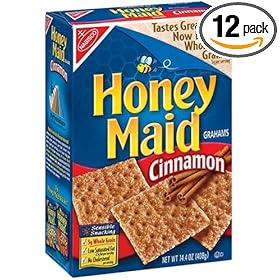
A few days ago, Amelia asked if we could buy her graham crackers (I think they served them at school but she couldn't have them at the time because of her soy allergy), so since she can have soy now, we said yes. I went online and checked out Honey Maid Graham Crackers -- which, as you can see, from the ingredient listing (ENRICHED FLOUR (WHEAT FLOUR, NIACIN, REDUCED IRON, THIAMINE MONONITRATE [VITAMIN B1], RIBOFLAVIN [VITAMIN B2], FOLIC ACID), SUGAR, GRAHAM FLOUR (WHOLE GRAIN WHEAT FLOUR), SOYBEAN OIL, HIGH FRUCTOSE CORN SYRUP, PARTIALLY HYDROGENATED COTTONSEED OIL, HONEY, LEAVENING (BAKING SODA, CALCIUM PHOSPHATE), SALT, ARTIFICIAL FLAVOR, SOY LECITHIN-AN EMULSIFIER, CORNSTARCH) contains wheat and soy but no other top-8 allergens. Since it's the top graham cracker brand (or it seems to be, from all their marketing and shelf-hogging at the supermarket) and part of Kraft, I felt pretty confident that if the label didn't list a food, it wasn't in there.

I did one last scan of the box before I gave it to her, and noticed the Kosher Dairy symbol on the front (meaning in some way, shape, or form, there is dairy in this box). Super annoying and frustrating! I sent them an e-mail and I'll update when I hear back from them, but with a major food company like this, if there's some trace amount of dairy in their food, they should tell people.

Can you see the D on the front of the box? Grrr. It should be an "F" because Kraft, YOU FAIL!

Monday, November 23, 2009

4% of U.S. children have food allergies, analysis finds -- latimes.com

In this LA TIMES article, they report on the latest findings about food allergies, including that 4% of children in the United States have food allergies, and that there is a rise in cases, not just in diagnosis of the problem. No surprise there, at least for those of us dealing with food allergies, but always glad to see a mainstream publication giving attention to the problem. Read on, here:

4% of U.S. children have food allergies, analysis finds -- latimes.com

Check out FAAN's new web site

Congrats to FAAN (The Food Allergy & Anaphylaxis Network) for re-launching their web site, which can be seen here: http://www.foodallergy.org.

Their old one was, admittedly, hideous -- with a layout that made it seem like a high-schooler built it back in 1996, so this is a much-needed improvement. You can subscribe to get alerts about undeclared allergens in foods, do a recipe search, and find out more about a particular allergen.

Congrats, FAAN, and thanks for your work on behalf of people with food allergies.

Wednesday, November 18, 2009

Food Challenge

Does the idea of bringing a young child to a hospital, telling her to eat a food she's never had before, and explaining it MIGHT make her sick sound fun to you? Wait, what if the kid is high-strung around doctors to begin with, and has had bad reactions to foods in the past? How about if she takes weeks or months to warm up to a new food? Yeah, and that she has to have six to eight ounces of it to see if she can manage it? If this sounds like an excellent way to spend a few hours, congratulations, you're a stronger person than me! Because the most challenging thing about Amelia's "food challenge" last week at Mt. Sinai was coming up with ways to make the experience as bearable as possible for her.

Let me back up for a moment. This summer, Amelia had her annual allergist appointment, where they did skin prick tests on her arm and *tried* to draw blood, but she got so upset they had to give up. So we did the bloodwork a few weeks later up near us, which went a lot better. The two tests showed that she had a good chance of being able to eat soy, so we decided to go ahead and do a "food challenge" (which is where a child, under the care of a doctor, eats a certain amount of a food and is observed for a reaction. No reaction? You have "passed" the challenge.)

Amelia was game about trying the chocolate soy drink (we'd built it up in the week before) but after one tiny sip she decided she didn't like it. Uh-oh. Much begging, cajoling, hectoring, bribing (Skittles), and gnashing of teeth ensued. We even mixed it in to her juice drink to hide the flavor. After, seriously, HOURS, she'd drunk about two ounces of the stuff, not the called-for six to eight. Sigh. Dr. Sicherer wasn't thrilled, but he was good-natured enough about it, and said that we should just continue to feed her small amounts of soy at home and watch for a reaction (such as eczema, or possibly, a flaring-up of her reflux).

So far we've tried to give her grilled cheese (with soy cheese, of course) and she took a teeny tiny scrape with her teeth. Not sure she even got any soy in that. Tonight Len's going to make a pizza. But I think I'm going to have to hide it in stuff, like pancakes or muffins, rather than get her to eat a brand-new food, which is always tricky.

Needless to say, the day sucked, but it's over and it appears she can start eating soy, at least in small amounts. She did pretty darn well for a four-year-old, actually -- considering her past bad experiences with doctors and with food.

Bring on the tofurky!

Friday, November 13, 2009

Keeping Allergies Off the Table

My man Ming Tsai (looking smooth, left) has a cool article in The Atlantic about how he keeps his food-allergic patrons safe when they dine at his restaurant, Blue Ginger. I love this guy.

Keeping Allergies Off the Table: "An award-winning chef explains why he makes his restaurant safe for people with food allergies...."

Monday, November 2, 2009

It's just nuts

It's just nuts, otherwise known as yet another article about how people are overreacting to food allergies. Sigh. I guess for everything there must be a backlash.

The author, Patricia Pearson, writing in Canada's Chatelaine, raises some good points. Those include that there is probably some overdiagnosis happening; that teaching kids safe habits like hand-washing and not sharing food is probably better than trying to make schools nut-free; and that most people are not allergic to food that is airborne.

Unfortunately, her arguments are totally lost in her one-sided article, which she starts off with (warning: ANNOYING parent alert) a kvetch about her son who is SO picky he won't eat mac & cheese made with certain noodle shapes and how horrid it is he can't bring a pb sandwich to school. Yep, way to make yourself sound like an ass, Pearson. Also, she doesn't factor in to account stuff like ages -- a 13-year-old can wash hands and not share food, but can a five-year-old avoid sticking their fingers in their mouths after touching a (possibly food-contaminated) desk?

I agree that there should be more research on food allergies as well as good, clear plans for having kids with food allergies in schools so that the kids are kept safe AND the rest of the student body can eat in peace, but this was not the article to try to find a rational middle ground.

If Pearson's biggest problem is a picky eater, she should a) count herself lucky and, excuse my language here, but b) stfu.

Want to read the whole magilla? Go right ahead, here!

Tuesday, October 13, 2009

A "allergy threat is overblown" themed article on Slate.com

There have been a few of these articles lately -- basically pointing out that the fear of food allergies far outweighs the actual risks from them. Author Agreed 100% -- HOWEVER when it's your kid, it doesn't feel overblown at all. She also takes Hugh Sampson and Scott Sicherer (both are allergists at the Jaffe Food Allergy Institute at Mount Sinai, and Dr. Sicherer is Amelia's allergist) to task for not doing good statistical work to get a better sense of what they claim is an increase in the rates of food allergies. I do find it hard to believe that Broussard has blown the lid off of some medical scandal that no one else, including other allergists, hasn't seemed to figure out. The author also alludes to the doctors as having ulterior motives, and big pharma as wanting to make big bucks off finding a cure to food allergies (ya think?) in a way that's pretty sinister.

I could also live without Broussard's snarky tone, like this paragraph: The seafood study wasn't just used to legitimize food allergies inside the medical community. It also became a handy political weapon. In 2004, FAI hired a consulting firm to devise a plan to include specific ingredient information on food labels. Tax forms show that those expenses "included mailings to the public to help support the proposed legislation." Food allergy legislation was soon proposed by Rep. Nita Lowey, D-N.Y., and passed into law. We experience it now as the Food Allergy Labeling and Consumer Protection Act, the law that requires cream cheese to bear the label "contains milk."

Considering our current problems with our food supply, I don't think a law mandating more transparent labeling is such a bad thing, do you?

Want to read the whole piece? Check it out for yourself here.


P.S.
The illustration above is from Slate's feature, and is by Mark Alan Stamaty. Dude, talk about obvious! Sheesh.

Wednesday, September 30, 2009

Yummy Allergen-Free Snacks (from Parenting Magazine)

I think someone at Parenting magazine has a kid with food allergies, because this isn't the first time I've seen them cover the topic. In their October issue, they have a really cute, full-page roundup of allergen-free snacks, which you can also see on their site.

Some of them might not work for Amelia, but it's still such a cool thing to open up a major magazine and see them devoting so much space to the issue of allergies. Yay!

Tuesday, September 22, 2009

Is Coconut a nut?

I can't seem to find any good info on this -- is it a nut? And if not, why do they call it coconut? Although I guess nutmeg isn't a nut, and eggplant isn't an egg. The English language is weird.

Tuesday, September 8, 2009

What to Do With a Well-Meaning Mother-in-Law?

My mother-in-law is very, very nice. She loves the grandkids. She really wants Amelia baby J to be happy and healthy. What is she not so hot at? READING LABELS AND BEING AWARE OF POTENTIAL ALLERGENS. We bumped into her and grandpa yesterday at the Farmer's Market, and to cheer Amelia up (bee phobia), grandma gave Amelia a lollipop that one of the stands was giving away. But she didn't ask me if it was okay, nor did she read the label. In a stroke of really good luck, it was the brand that Amelia's okay eating (Dum-Dums). But still... .

So, when your mother-in-law does something you're not comfortable with, and it pertains to a safety issue, what do you do? I did the "whoa, hey, let's not forget to read labels next time first!" (trying for a jokey and casual voice) thing, but I don't know if that was effective or just went in one ear and out the other. I keep hoping she'll "get it" but we've had quite a few of these close calls (closer than this, which wasn't too bad) which I catch and fix without making a fuss, but is that the best strategy? I'm stumped, and worried the next time I may not be there. This is why I won't let her cook for Amelia or be in charge of any meals other than a snack I send over.

Or maybe that's okay -- I am her mom and it's my job to feed her, not anyone else's. Grandma's around to be a loving and fun presence (which she is).

Gerber Cereal: FAIL!

My mother-in-law stopped by with some baby food for John recently. One of the items she bought was a box of Gerber's "single grain" oatmeal cereal. Single grain my foot. Soy oil-lecithin is the third ingredient (after, thankfully, oat flour). That's just gross, and weird. Why the soy? For flavor? Bulk? A cheap filler? Whatever the reason, I'll pass. I realize most soy-allergic people are not allergic to soy oil or soy lecithin (Amelia included) but there's still no reason to add anything to a single grain baby food other than the grain, and some vitamins/minerals (a key one being iron, which babies need).

Gerber in general has always bugged me. Maybe because they seem to own the market due to sheer advertising muscle. But two different nutritionists I know say they prefer Beech-Nut. And I also like Earth's Best. Regardless, this is not cool. Gerber: FAIL!

Monday, August 31, 2009

Milky Way

Want to hear something weird? Most of the world's population actually can't digest milk. According to a recent USA Today article, "Somewhat less than 40% of people in the world retain the ability to digest lactose after childhood. The numbers are often given as close to 0% of Native Americans, 5% of Asians, 25% of African and Caribbean peoples, 50% of Mediterranean peoples and 90% of northern Europeans. Sweden has one of the world's highest percentages of lactase tolerant people."

The really weird part is that "[b]eing able to digest milk is so strange that scientists say we shouldn't really call lactose intolerance a disease, because that presumes it's abnormal. Instead, they call it lactase persistence, indicating what's really weird is the ability to continue to drink milk."

So those of us who can chug milk or munch on tons of cheese are actually in the minority. Granted, having an intolerance probably won't send you to the hospital in dire need of Epinephrine the way having an allergy to dairy will, but consuming milk products can still make you feel lousy and people with a lactose intolerance still have a tough time navigating restaurant menus.

Saturday, August 22, 2009

Chicken Nuggets Are So Yummy

I never got into chicken nuggets. When I was a kid and we went to a fast-food place, I stuck with the tried-and-true basic burger. As I got older, of course, they just seemed sort of gross (is there even chicken in those things?). But then I discovered the yummy brand of chicken nuggets. They're definitely a step up from the usual (all chicken breast, all natural, etc.) and they taste amazing. (Greasy and rich and all that, but if you're three, why not?) They're good enough that I'd want them for a meal now and then myself (dieting issues not withstanding).

We had made them a billion years ago for Amelia and then she went through her chicken boycott phase, so we forgot about them for a while, but recently when we realized we needed to broaden her diet just a wee bit, we tried them again. The first time was a dud -- she dumped her "dipping sauce" (maple syrup) over them, they got cold and soggy, and that was the end of it. This time, we cut them up into smaller pieces and gave her a fork (she isn't a huge fan of getting greasy fingers) and she totally ate them. Not a TON, mind you, not like her 1/4 lb. of turkey she can pack away, but still, a respectable, pre-schooler serving size. They cost more (sigh, of course) but they're so worth it. Here's what's in them: Chicken Breast Meat, Water, Salt, Breaded with Unbleached Wheat Flour, Evaporated Cane Juice, Dried Yeast, Spices, Paprika. Flash fried in non-hydrogenated soybean oil to set breading. Not bad, right?

Soy Confusing!

You know what's weird? That people with soy allergies can eat soy lecithin and soybean oil. I guess those two soy products have been broken down so much that the body can't "recognize" that it is actually soy, and won't react with an assault.

Anyway, when I read a label and the allergen statement says "contains SOY" I put it down and move along. But then Amelia asked for animal crackers (where did she even learn what those were?) I figured I'd start looking to see if we could find an okay brand for her. Barnum's Animal Crackers seemed to fit the bill -- it had the "contains SOY" labeling so I'd never bought them for her before, but upon further review, the only soy was the above-mentioned soy lecithin and soybean oil. It was confusing, though -- why was the company labeling for soy as an allergen if the only soy was the okay kind? I even ran it by Amelia's dietitian, who gave us the okay, so we let Amelia have some of these last week. She liked them okay but didn't seem to be in love, but I think she was really happy that she asked for a certain food and was able to have it. Of course, her dad and I devoured the whole stupid bag of them on a recent long drive. Argh.